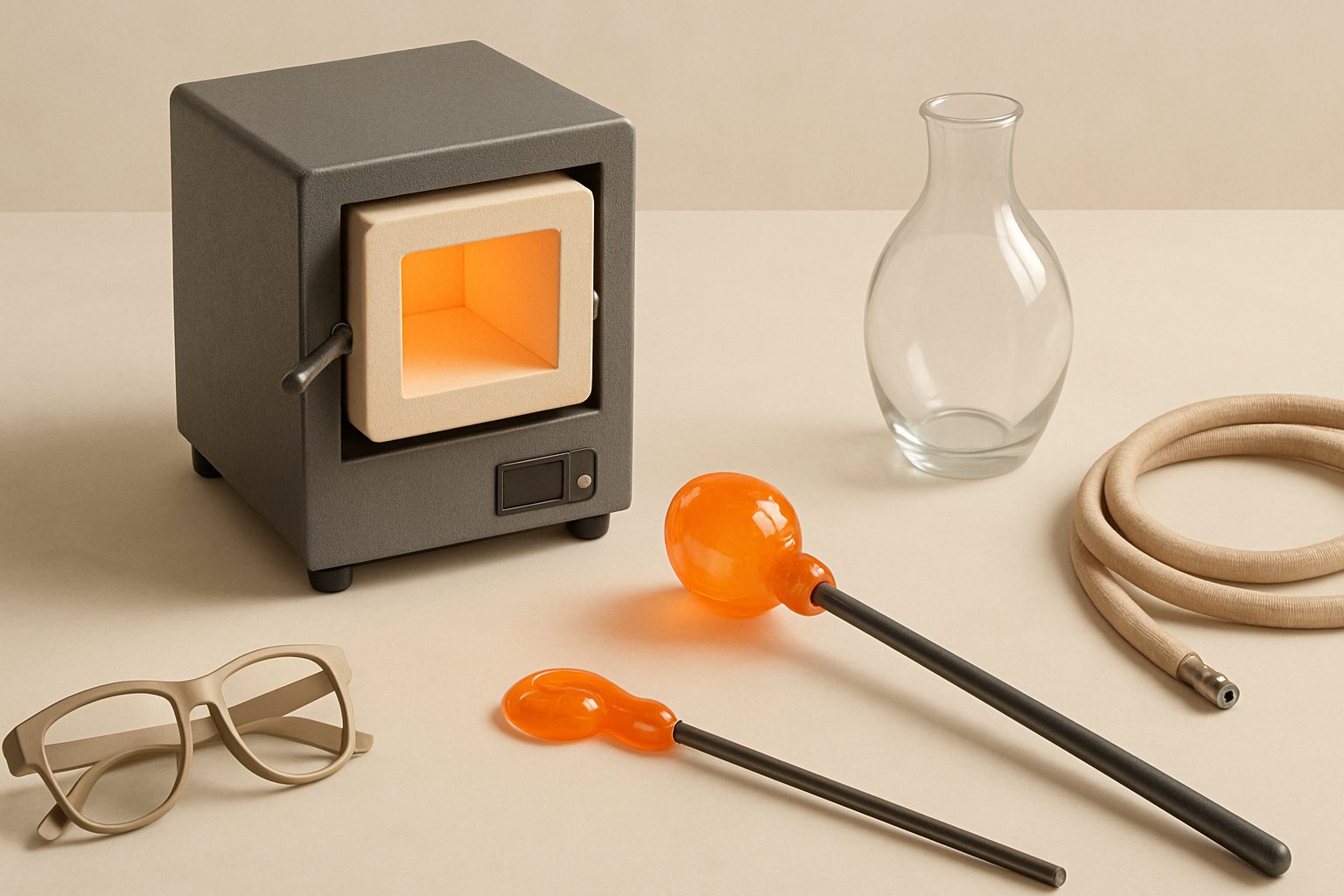
Best Small Glass Kilns for Flat-Working Hobbyists in the UK
If you're getting into glass fusing, slumping, or jewellery making at home, a full-size kiln isn't practical or necessary. Tabletop and compact kilns designed for flat-working are perfect for UK hobbyists – they fit on a workbench, heat up quickly, and many run straight off a standard 13A socket. Here's what you need to know to choose the right one.
Why Size Matters for Flat Work
Flat-working – fusing tiles, panels, and jewellery – doesn't require the massive firing chambers that glass-blowing demands. A small, square kiln heats more efficiently and reaches temperature faster, cutting energy costs and reducing your wait time between projects. A compact model also means you're not paying for wasted space you'll never use, and your workshop stays comfortable instead of becoming an inferno.
Most hobbyists find a working chamber of 20–30cm square is plenty. Anything smaller risks crowding pieces; anything larger and you're heating unnecessary volume. Depth matters too – 15–20cm is the sweet spot for slumping moulds and stacked fusing work.
Kiln Types to Consider
Square-chamber models are the standard for flat work. They heat evenly across the chamber and stack tiles or panels efficiently. Look for kilns with good insulation – ceramic fibre or brick construction with a proper outer shell. Cheap models often skimp here, and you'll feel the heat radiating into your studio.
Top-loading versus front-loading depends on your space. Top-loaders are more compact and slightly more efficient, but front-loaders let you see inside during firing and are easier on your back if you're loading regularly. Most tabletop models are top-loaders simply because they're simpler to manufacture.
Kiln furniture – the shelves, stilts, and props inside – should be ceramic fibre or high-alumina. Cheap steel furniture rusts and contaminates your glass. Budget for replacement furniture; it wears out faster than the kiln itself.
Power and Wiring: The 13A Question
This is crucial for UK hobbyists. A standard 13A socket delivers about 3kW continuously – enough for kilns up to roughly 3–4kW rated power. Many small kilns in the 1.5–2.5kW range run comfortably off a single socket, though you shouldn't run them flat-out for hours while simultaneously using a kettle or heater in the same room.
Check the kiln's actual wattage rating, not just the "maximum temperature" claim. A 1300°C kiln might draw 1.8kW or 4kW depending on insulation and element design. Ask the supplier for the power consumption at operating temperature, not just the nameplate rating.
If a kiln needs more than 13A, you'll need an electrician to install a dedicated circuit – fine if you've got the budget and space, but that adds cost and complexity. For genuinely portable hobby work, a 13A-compatible kiln is simpler.
Temperature Range and Control
Most flat-working kilns reach 1200–1300°C, which is more than enough for fusing borosilicate or soda-lime glass and all jewellery work. Anything hotter is unnecessary unless you're planning to move into glass-blowing later – in which case you'd buy a blowing kiln anyway.
Control matters more than maximum temperature. A kiln with a basic on/off switch or a simple dial thermostat is fine for fusing – you're aiming for a specific temperature and holding it, not ramping through complex firing schedules. If you think you'll do more elaborate work later, a kiln with a programmable controller is worth the extra cost, but don't pay for it upfront if you're just starting out.
Build Quality and Longevity
Ceramic fibre insulation is standard and works well, but it breaks down over time – expect gradual efficiency loss after a few years of heavy use. Kilns with a proper outer shell (metal or ceramic) protect the insulation and make the kiln safer to touch. Bare fibre kilns are cheaper but get damaged easily and shed particles if knocked.
Check where the elements (the heating wires) are positioned. Elements built into the walls or roof are fine; elements sitting loose on the floor will sag and fail sooner. Good kilns have elements threaded through grooves or channels in the insulation.
The door seal matters too. A poorly fitting door lets heat escape and means the kiln works harder and costs more to run. Ceramic fibre rope seals are standard; some models add a mechanical latch. A loose door is a false economy.
Real Running Costs
A 2kW kiln firing for 4 hours costs roughly 25–35p in electricity (depending on your rate and local pricing). That's affordable for regular hobbyist use. A smaller 1.5kW kiln might cost 20p per firing. These aren't huge numbers, so don't over-optimise – a slightly larger kiln that's more pleasant to use is often worth the extra pennies.
Maintenance cost is low if you avoid overfiring and don't crack the chamber. Replacement elements run £30–60 and last 3–5 years with sensible use. Shelves and furniture are consumables; budget £50–100 per year if you're working regularly.
The Practical Choice
For most UK glass-fusing hobbyists, a 2–2.5kW tabletop model with a 20–25cm square chamber, simple temperature control, and ceramic fibre insulation does everything you need. If it runs off 13A and has a decent outer shell, you're looking at a solid, functional kiln that'll last years of regular use without drama.
Avoid the absolute cheapest models – they often have poor seals and thin insulation that make them frustrating to run. Equally, don't overpay for features you won't use. A kiln that reliably reaches temperature and holds it steady is more valuable than one with a fancy controller you'll never programme.
More options
- Paragon Kilns (Glass & Jewellery Range) (Amazon UK)
- Skutt Glass Kilns (Amazon UK)
- Digital Kiln Controllers & Pyrometers (Amazon UK)
- Glass Fusing Supplies & Kiln Furniture (Amazon UK)
- Lampworking & Glassblowing Tools (Amazon UK)